 Vermont Fish and Wildlife officials confirm that a young male bear was shot and killed in Woodstock Village in early May. The bear was taken in the area of the River Street cemetery after long-term reported nuisance behavior this spring and official attempts to scare it away from residential homes.
Game Warden Steve Majeski says the bear, who was reported by many in the neighborhood, had become so emboldened by bird seed and garbage left out in the area of North and River Streets that it started breaking into homes. The “dispatch” of the bear followed previous action taken several weeks ago by game officials, with knowledge and support from Woodstock Police, who tried to scare off the bear with rubberized bullets. But apparently it was to no avail.
Officials say they’ve had more than 75 reports this spring about the “nuisance” bears from Woodstock Village residents complaining about the bear or bears getting into garbage and eating birdseed.
Majeski says final action was taken after the bear was reported to have climbed up a drain pipe on the side of a North Street home, then broke through onto the second floor screened-in porch. Following that, within the same 24 hours, the bear also entered another homeowner’s garage in the area of the River Street cemetery attempting to go up stairs into the home. At that point the decision was made that the bear now represented a potential threat to human life and property.
State Game Warden Chris Connor says it is extremely rare for wildlife officials to be compelled to kill a bear in this way but when it crosses over from “nuisance” to full-on destructive or potentially unsafe the law says the bear can be taken. Garbage left strewn around by a bear is an annoyance, but officials say it is entirely preventable as is removing birdseed from property. It is not enough to warrant killing a bear. Connor says the cases in which a bear may be killed, out of regular bear hunting season, is if it presents a threat to humans, livestock, chickens, beehives, buildings or vehicles.
After investigating the most recent and brazen bear reports, then following the bear into the woods, Majeski says another consideration he made in deciding to shoot the bear was that it was quite small but already habituated to breaking into property to find human food. As it grew larger, Majeski thinks it might have easily become a larger and greater safety threat, “With another 100 pounds on him as an adult, I had to think of that, too.”
It’s believed the young bear was one of two born last season that had been seen over the last year in the Woodstock/Mt. Tom/National Park area.
Connor confirms there have been separate reports recently of another bear getting close to property in the area of Gully Road and over near Teago Store in South Pomfret.
All the game officials we spoke to emphasized the best way to protect bears, human life and property is to learn more about the bear’s habitat and behavior. “They are extremely intelligent creatures,” says Vermont wildlife biologist Forrest Hammond who is the chairman of the state’s black bear program. He cites studies of bears in Yellowstone National Park which were shown to have learned which vehicles were Forest Service or National Park vehicles. These particular bears learned to stay way from official vehicles while continuing to aggressively seek food from non-government vehicles. Hammond says they can learn where there is a threat and where there is not a threat to their natural instincts at foraging for food.
Of course we all love seeing wild bears. They’re fascinating. And, it seems like no better idea than to get a photo or video of a bear at a bird feeder or just in the back yard. But game officials say we should be getting rid of the bears by clapping our hands and scaring them away — immediately. The best way to protect them from harm is to get them back into the wild and out of the urban interface — get rid of the bird seed in the winter feeders, clean the grill and put away the garbage. Hammond adds, “It’s neat to see a wild black bear…but you need to clean up your yard..it’s the worst thing to stand there and take a picture.”
Asked about the bear being shot and killed, Woodstock Town Manager Phil Swanson said he no personal knowledge of the incident. Woodstock Police Chief Byron Kelly, Jr. referred all questions about the incident to Vermont state officials. However, Woodstock Village Trustees were informed of the earlier unsuccessful attempts to scare the bear with plastic bullets.
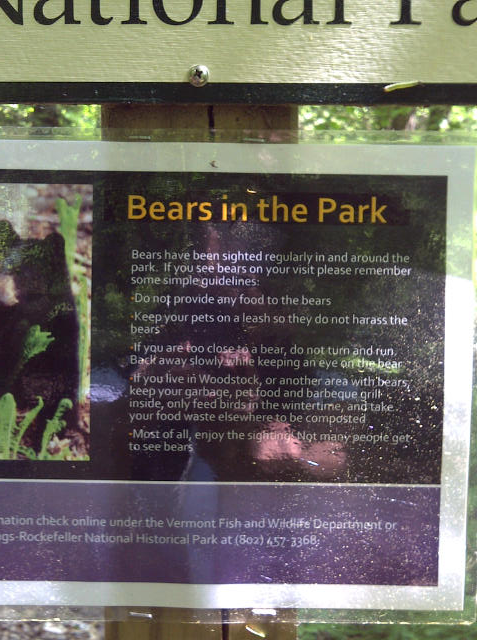
For now, trying to keep people safe as they hike in local park areas, educational warning signs have been posted about bears at entrances to the Mt. Tom and Marsh-Billings-Rockefeller National Historical Park. One sign is very visible going up the trail from the River Street cemetery near where the bear was killed. However, local naturalists who spend a lot of time on Mt. Tom say they haven’t seen any bears recently since the one bear was destroyed.
To answer questions about bears, bear behavior and how to stay safe living with bears, The Woodstock Conservation Commission along with federal, state and local officials will host an informational meeting about the Eastern Black Bear at the Woodstock Town Hall this coming Monday night, June 13th at 7:00pm.
Guests include Vermont State Wildlife Biologist Forrest Hammond and National Park Service biologist Kyle Jones.
To get started on some bear information here is one link to the Vermont Fish and Wildlife website:
http://www.vtfishandwildlife.com/wildlife_biggame.cfm#bb
###
The Early Bird Gets the Worm — This story comes to you as a result of an “Woodstock Early Bird” tip. Send yours: earlybirdtips@yahoo.com




 Julia Carlisle
 Woodstock Early Bird