Good Morning Early Birds, This is from today’s Vermont Digger report which can be found with state-wide information about the Aftermath of Irene at : www.VTDigger.org:
By Anne Galloway, VTDigger Editor
Three days into the aftermath of Tropical Storm Irene, the Shumlin administration has made good on an ambitious promise made two days ago: The Agency of Transportation, Vermont National Guard and private contractors have carved emergency exit routes into all 13 communities, which were isolated by the raging torrents that made mincemeat of state highways on Sunday.
That isn’t to say that two-way paved roads have suddenly replaced the asphalt infrastructure that Irene tore up like so much confetti. Access, in this case, means negotiating rough rocky passages with a Jeep and 4-wheel drive truck.
The new passages aren’t designed for residential travel. They are strictly to be used as emergency access routes for first responders, supply vehicles and the Guard, according to Chris Cole, a deputy director of the Agency of Transportation. One of the ways locals are getting around is via ATV travel via logging roads likely remains the best option for Vermonters who are marooned in remote areas of Vermont near the Green Mountain National Forest like Brandon, Stockbridge, Rochester and Granville.
Stranded out-of-staters are using other forms of transportation to escape rural isolation. On Wednesday, a Wall Street trader hired a private helicopter for $7,000 to spirit his family away from Killington where they were trapped for three days.
http://www.bloomberg.com/news/2011-08-30/vt-floods-force-fund-manager-to-hitch-copter-ride.html
The creation of new transportation routes is a sign that the Shumlin administration is beginning to shift from emergency response mode to the recovery phase. On Monday, 236 people were in shelters. That number has dwindled to 47. Power outages have been reduced from more than 50,000 to less than 10,000. More than 260 roads were closed on Monday; the number is now 64, according to the Shumlin administration. Route 100 alone has six major road carveouts. Chester, Rochester, Wilmington, Mendon, Killington, Cavendish, Ludlow, Middletown Springs, Granville, Stratton, Pittsfield and parts of Stockbridge are still inaccessible.
The first order of business remains ensuring public safety, according to Jeb Spaulding, the secretary of the Agency of Administration. More than 350 Vermont Guard members are helping to move supplies, clear roadways and helicopter ready-to-eat meals, medical supplies and water to communities cut off from the state highway system. Another 100 members from the Illinois Guard are coming to help out, as well. New Hampshire has loaned helicopters. FEMA is providing on-the-ground logistical support and has brought in 30 truckloads of emergency goods to the state (20 more are coming). The Vermont State Police has 120 law enforcement officials helping to stabilize communities traumatized by Irene flooding. In addition, game wardens, Department of Motor Vehicle officers and liquor control officers are assisting the police by carrying commodities to homes and checking on Vermonters who may need help. Fire safety inspectors are evaluating structural damage to flood-wracked buildings. The U.S. Border Patrol and the county sheriffs and municipal police departments have also offered to assist in the recovery.
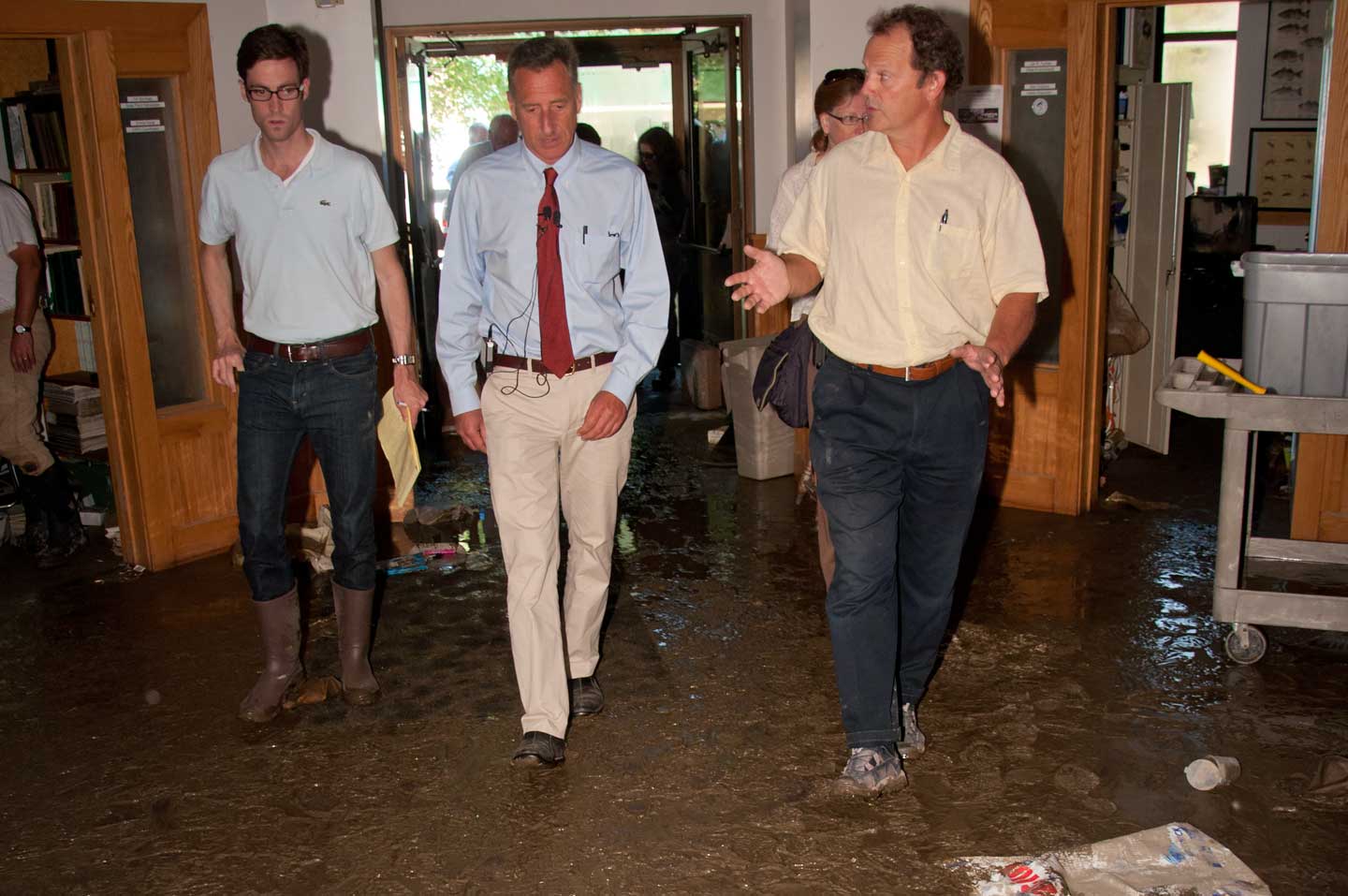 Gov. Peter Shumlin talks to Agency of Agriculture Secretary Chuck Ross while touring the state office complex in Waterbury. VTD/Josh Larkin
The challenges, however, remain daunting. About 120 homes were destroyed or sustained major damage. Thirty-five bridges out of 41 that were closed on Monday remain cordoned off; east-west access is now very difficult because Route 9, Route 4 and Route 103 are impassable in places. Large sections of state highway have disappeared (including a half mile section along the White River on Route 103 that has essentially reverted to riverbed). Power lines have disappeared, and the Rochester substation has been destroyed. Freight and passenger rail lines have been disrupted.
The No. 2 priority? Assessing the damage from Irene and getting cost figures to FEMA as soon as possible. The state is busy inventorying the public and private property losses so that it can file for major disaster relief with the White House as soon as possible, Spaulding told reporters at a press conference. He hopes to have a letter to President Barack Obama within 24 hours to 48 hours.
Sen. Bernie Sanders, I-Vt., announced that the first installment of federal transportation aid had been approved — $5 million for roads and bridges – on Wednesday.
Major public assistance shouldn’t be difficult to obtain, Spaulding said, because the state has clearly had more than $1 million worth of damage (the FEMA threshold). The funding would pay for the renovation of the Waterbury state office complex through a 75 percent federal-25 percent state match. Gov. Peter Shumlin said in a press conference on Tuesday that he didn’t think dipping into the budget stabilization fund to pay for the 4-to-1 match is appropriate.
Garnering federal assistance for private homeowners and businessowners, however, will be more difficult, according to Spaulding. FEMA makes a determination of funding based on the number of residences that have been destroyed and the scale of the disaster.
“We are hell bent on getting assistance, particularly to individuals,” Spaulding said.
Creating an east-west travel corridor is another top-of-mind priority for the administration. At present, there is no direct route through Southern Vermont from New Hampshire to New York state.
The Agency of Transportation has formed to “incident command centers” – one in Rutland and another in Dummerston – that will be responsible for coordinating recovery efforts between local, state and federal entities.
The Shumlin administration is also struggling with communications glitches. The 2-1-1 call center for assistance was operated by two staffers on the Fifth Floor on Tuesday, and it didn’t take long for the switchboard to become jammed with calls. On Wednesday, Spaulding announced the state found eight volunteers to field calls; it wants to hire a dozen more. “We need volunteers to help take those calls,” Spaulding said.
The automated 5-1-1 telephone system used for identifying road blockages was disconnected on Wednesday afternoon because it wasn’t transferring calls properly.
That problem was temporarily solved by Matt Dunne and Google late on Wednesday. The Internet search engine company worked with state officials to produce a map of the state that includes information about what bridges are open or closed




 Julia Carlisle
 Woodstock Early Bird