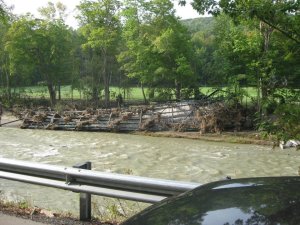
The Remains of the Holt Iron Bridge
The headline out of last night’s Woodstock Selectboard Meeting is that — so far — Tropical Storm Irene Flood Damage projects have reached close to the $2 million mark. Town Manager Phil Swanson reported the costs so far as $1,965,992.
Separately, the Town has invested $257,119 on repairs to the town sewer system (which is separate from the Village and Town drinking water system run by privately owned Woodstock Aqueduct Company). So far, FEMA has not reimbursed Woodstock for its expenses, although Swanson says the monies are expected soon.
After Irene struck, the Woodstock Selectboard decided not to re-build for the Holt Iron Bridge which was located several miles out Route 4 along the Ottauquechee in West Woodstock. However, the town can still get and make use of a large chunk of the FEMA money that would have gone to the bridge replacement.
At Tuesday’s Woodstock Selectboard Meeting Municipal Manager Phil Swanson explained that, in some cases, if a town declines to do a particular repair project after a disaster, the municipality can apply to FEMA to use a portion of that money for other municipal projects that FEMA deems worthy. FEMA standards include that a newly proposed municipal project must serve a public purpose, must be over $5,000 and the final result of each project must last for over 3 years.
In addition, for these alternate projects, FEMA will approve no more than 75 percent of the originally declined project’s estimated cost (The Holt Iron Bridge replacement was estimated at $880,000; 75 percent being $660,000).
Swanson is proposing to use the monies to replace 35 sets of firefighter gear. The town’s firefighter gear is “reaching the end of its useful life,” Swanson said, adding that the standard is to replace the suits after 10 years. The Woodstock Fire Department’s gear will be 10 years old this summer, according to Swanson.
Also, Swanson told the Selectboard he wants to include on this project list a request to replace the Town’s salt shed, which is “looking very tender.” He said the structure went up in the 1950s, and a replacement could create a larger building which could also house the town’s sand. Both the salt and sand are used to treat public roads that become icy or snowy during the winter.
The Selectboard expressed no objections to Swanson’s proposals. The final decision will rest with FEMA, after the cost estimates are finalized and submitted. There were no estimates shared Tuesday evening on the cost for a new salt/sand shed. However, Swanson was more specific about getting 30 new sets of firefighter gear; that cost is estimated at $70,000.
To be eligible for FEMA coverage, an Irene-related expense must be over $1,000 and must be a material project, according to Swanson. In some cases, he added, the town has been able to “string together” smaller projects to meet that dollar amount. As an example, the town combined several projects related to water distribution after the flood – which Woodstock’s FEMA field rep approved for submission.




 Julia Carlisle
 Woodstock Early Bird