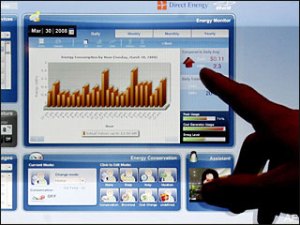
We’ve have had several Woodstock Early Birds contact us with concerns about the implementation of the Central Vermont Public Service “Smart Meter” program, which, rather than providing an “opt-in” clause for customers, is being implemented with an “opt-out” clause that requires customers to pay extra for what is now a routine visit from the “meter man/woman.”
On the one hand, the smart meter plan is basically an effort by CVPS at stream-lining its meter-reading systems using new technology while maintaining a better “eye on the grid.” However, this 24/7 monitoring of electrical usage has some folks in Vermont concerned from a privacy standpoint.
In addition, Woodstock Early Birds have informed us that some are also concerned about RF (radio frequency) “radiation” issues that may result from having the smart meters affixed in or on their homes.Update on this facet of the issue. We have news of an information session about potential RF-related health issues at the Norman Williams Public Library:
SMARTMETERS – HEALTH IMPLICATIONS
Wednesday, April 25th
5:30 – 7:30 pm
Norman Williams Public Library
If you are a CVPS residential customer, for a limited time, you will be given a chance to decide whether or not the electric meter upgrade is the best choice for you. According to CVPS, these new meters are two-way radio frequency devices which send and receive information wirelessly.
Janet Newton of the EMR Policy Institute, a non-profit working to advance sound public policy in the area of wireless radiation, will be available to discuss and explore the recent Vermont Department of Health report addressing radio frequencies, radiation, health and smart meters.
FREE AND OPEN TO ALL
We, here at Woodstock Early Bird, after having been informed of controversy over smart meter issues, have read several very informative and thorough articles in the past few months on the subject in both the Rutland Herald (Bruce Edwards) and at http://www.VTdigger.org. The Valley News has also covered the smart meter installation story.
In any case, herewith another opportunity to get some comprehensive information. A panel discussion on the potential benefits and problems associated with smart electric meters:
Thursday, May 10 at 7 pm in Woodstock Town Hall.
Panelists:
Vermont Dept. of Public Service Jim Porter
Vermont Law School Kevin Jones
CVPS meter engineer Rick Hackett
Vermont Representative Alison Clarkson
Vermont Senator Dick McCormack
Sponsored by Sustainable Woodstock. For information call 802-457-2911.
Note: The photo above comes from an online article about




 Julia Carlisle

Posted by jack Rossi on April 19, 2012 at 16:06
This is a very serious issue with potentially long lasting health repercussions to the general population. I would encourage anyone interesest or concerned about smart meter use and effects to visit http://www.EMRPolicy.org.
Jack
LikeLike
Posted by Jennifer on April 24, 2012 at 10:50
I agree with Jack. Smart meters are an intrusion of privacy! They have also been linked to fires and upsurges in electrical pricing in the areas where they have already been implemented. And most importantly.. they are not Safe! I urge people to read the letter asking for a moratorium on smart meters authored by the American Academy of Environmental Medicine this spring (2012) available in its entirety at http://www.aaemonline.org. There are plenty of references sited at the end of the paper.
Here is an exerpt from their letter: ” For over 50 years, the American Academy of Environmental Medicine (AAEM) has been studying and treating the effects of the environment on human health. In the last 20 years, our physicians began
seeing patients who reported that electric power lines, televisions and other electrical devices caused awide variety of symptoms. By the mid 1990’s, it became clear that patients were adversely affected byelectromagnetic fields and becoming more electrically sensitive. In the last five years with the advent of wireless devices, there has been a massive increase in radiofrequency (RF) exposure from wireless
devices as well as reports of hypersensitivity and diseases related to electromagnetic field and RFexposure. Multiple studies correlate RF exposure with diseases such as cancer, neurological disease,reproductive disorders, immune dysfunction, and electromagnetic hypersensitivity.”
What about children and infants whose bedrooms are often just on the other side of the electrical meter? Do we care about the most vulnverable that do not have a voice?
While it is shameful that research was not completed before beginning the installation of the smart meters in our state, we still have the opportunity to stand up and voice a loud and strong “no” against smart meters. At the very least, we need to be afforded the opportunity to reject smart meters for our homes without an increased monthly fee – after all, we will be paying for the smart meters, already, through our electrical rates which incluce the cost of the massive smart meter project. This is Vermont! We are strong, independent and intelligent – Say No to Smart Meters!
LikeLike
Posted by Dave Brown, President & CEO MISys, Inc. on April 19, 2012 at 22:44
You should know that the “EMR Policy Institute” is a group of concerned citizen who are trying to influence public opinion against the deployment of Smart Meters. Their point of view is hardly unbiased.
I have reviewed the material on the EMR Policy Institute website and watched their videos just to educate myself. I have no particular leaning, but as a professionally trained Electrical Engineer, I can find fault with a great many of their “studies.” This leads me to wonder whether they are making up their data to support their conclusion. I hope you don’t accept this information without question. In my opinion, much of it is not factual. It’s just a point of view, but worthy of being aired. I urge you to attend.
Hopefully the NWPL will invite someone from CVPS to provide a balance to the information being presented.
LikeLike
Posted by Julia Carlisle on April 19, 2012 at 23:35
Dave,
Thank you for this information. We, at Woodstock Early Bird, think it IS important to learn what information is out there and about this new device and its potential impacts on health, privacy and our wallets.
However, I, too, have questions about a sort of generalized EMR/RF hysteria. I call it that because — although I am generalist — I have worked in the radio broadcasting arena for more than 30 years — as have thousands of other people — and I suspect that broadcasters who work in technical operations (as I have and do) are exposed to far, far more EMR than any individual homeowner ever will be with a smart-meter and we are not and have not been dropping like flies. As a radio broadcaster and technician it has been my experience that a reasonable degree of informed care should be taken without creating hysteria about this issue. That said, non-scientifically speaking, it is entirely possible that RF and EMR may affect individuals differently.
Dave, and others, there IS a different hearing on the Smart Meter issue than the one with the EMR Policy Insitute that features a panelist from CVPS that will be held in early May at the Town Hall. WEB
LikeLike
Posted by jack Rossi on April 20, 2012 at 06:32
Australia and Europe has been experiencing and discussing this issue far longer that the US. See typical example below:
Open letter to the Premier from a Doctor
Posted on March 30, 2012 by Stop Smart Meters Australia
22nd February 2012
To the Premier of Victoria
Mr Baillieu,
Since the completion of the smart meter roll-out in my area, I have been very, very sick.
I have continuous palpitations, chest pain, a weird taste in my mouth, loss of appetite, lethargy, dizziness, faint attacks, inability to concentrate and complete insomnia.
I have the feelings at home, in the street, in all the streets of my area and at the shops.
I am not able to function. I can’t work, I can’t look after my family, I need my husband, who is now the only breadwinner, to take care of me.
My symptoms only disappear when I am in an area without smart meters, in a large park or on the beach. When my husband drives me through the Melbourne suburbs, I tell him when I feel my symptoms abate, he stops the car and looks at house fronts and, sure enough, he sees the old-style meters. This can be reproduced very predictably.
We now have to sell our home and find a place to live, where I get few or no symptoms. In the long-term, we have no choice but to leave the state of Victoria, as even if I find a ‘symptom free’ home, my life would still be very limited, as I could not roam most streets, go to most shops, visit friends, work etc.
My family’s life has been completely ruined. We have lost everything we had worked for. My two teenage kids have to cope with the trauma and grief of the overwhelming loss that awaits us on a daily basis. I already can no longer work as a doctor, eventually my kids will have to leave their school, university, grandparents and friends behind.
This is all senseless and monstrous. Even in the big scheme of things, my life matters and so do the lives of those who depend on me, especially my family and friends, for whom I am not replaceable.
What happened to me was avoidable and clearly a breach of human rights – the right to health and the right not to be subjected to experimentation without my consent.
The community has never been consulted on the need for smart meters, or even well-informed.
With the mandatory Victorian smart meter roll-out we will have irreversibly compromised those democratic values that have defined Australia so far.
Dr Federica Lamech
This is not just about EMF radiation but microwave radiation (a recent phenomenon as far as the widespread magnitude/exposure is concerned. Many believe that this is just another cycle of technological/physiological public ignorance like X-ray machines in shoe stores and long term cigarette smoking – no one dropped like flies immediately from these either. I do agree that there is a wide degree of sensitivity to this among the general population – but let’s not forget about canaries in the coal mines – they died before the miners felt any distress.
No matter what anyone from CVPS or MISys says, and let’s not forget that this is their bread and butter, the truth is they have no clue as to the actual health repercussions from this new technology. Enough people have experienced symptomatic episodes to date that we should be extremely cautious.
LikeLike
Posted by Kathy Hinson on May 7, 2012 at 06:28
Please see the op-ed section of the May 3rd edition of the Vermont Standard, or the online investigative newpaper, the Vermont Digger and search for the article written about the smart grid by Boardman. This op-ed provides a summary of the Woodstock April 25th meeting on smart grid.
The radio waves sent out by smart meters are digital which means they transmit modulated waves at are number of frequencies. The intensity, day in and day out and the pulsed nature of the high frequency ping the meters make as they chatter to each other makes this technology different from other transmissions used in the past. The AMI meters have only been in use for a few years, and have resulted in several class action law suits.
I have never heard of any other wireless device causing so many people to feel they need to hire a lawyer shortly after the meters were installed. Maybe it is mass hysteria, or maybe there is a real issue here which didn’t exist in the past. One thing is for sure, it is not illegal to turn off your cell phone, but it is illegal to turn off your meter. In many places there was no opt-out until a class action lawsuit pressured the regulators to provide one.
Opt out is free until April 2013 at least. Why not at least ask for a better meter?
Perhaps there will be enough time between now and then for some productive dialogue to take place. The Public Service Board can take comments.
LikeLike
Posted by William Boardman on May 7, 2012 at 10:56
Here’s the piece referenced in the post above. While this is a fundamental issue — deliberately ignorant decision-making — there are a number significant issues that the EarlyBird seems to have no understanding of.
“SMART GRID” INITIATIVE MAKES US ALL UNWITTING GUINEA PIGS
BY William Boardman
WOODSTOCK — If your state was installing a new technology that would impact virtually everyone, you might assume your state was acting based on the most complete and current science available to protect everyone’s health.
If your state was Vermont and it was intent on installing wireless technology in every home and business, you’d need to know that your state is acting based on very limited science, most of it more than 25 years out of date, with little concern for anyone’s health.
Making this a matter of growing public concern is the state-sanctioned installation of “SmartMeters” (tradename) that expose people to radiation that has unknown consequences, but is suspected of causing a variety of physical ailments, from sleep disturbance and headaches to brain damage and cancer.
The United States allows greater exposure of its citizens to the hazards of wireless technology than any other country in the world and the U.S. Congress passed a law in 1996 that prohibits state or local governments from regulating wireless technology on the basis of health effects, Janet Newton of Marshfield, Vermont, explained at a public forum at the Norman Williams Public Library here April 25.
For more than 20 years, Ms Newton, has tried to persuade Congress and assorted federal agencies to expand and refine the health science of wireless technology, especially as it related to electromagnetic radiation (EMR). To further her work, Ms Newton founded the EMR Policy Institute, a scientific non-profit corporation dedicated to advancing sound public health polity. The Institute has engaged with state and federal agencies and legislatures, joined lawsuits, and held public forums, all with essentially the same message: you should know what you’re doing before you do it.
Electromagnetic radiation (EMR) is a natural phenomenon that includes light. EMR can be ionizing (such as X-rays, gamma rays, nuclear power, or nuclear weapons), and as such is a known cancer-causing agent. EMR can also be non-ionizing (such as cell phones, relay towers, power lines, chargers, or wireless electric meters), and as such is designated by the World Health Organization as a suspected cancer-causing agent.
The most recent research on the health effects of EMR dates from 1986 and serves as the basis for the Federal Communications Commission to regulate wireless technology. But this research deals with only one of EMR’s impacts, the thermal effect – overheating human cells and body, which is what your microwave does to food. And even that thermal research is limited, based only on a six-foot, 200-pound mature man, not smaller or older people, and not children or infants. What is the effect on them, short term or long term? The FCC doesn’t know, nobody knows.
A decade or so ago, when Ms Newton petitioned the FCC to expand and update the scientific basis for its regulations, the FCC responded that it was not a health agency and had no authority to improve its scientific data. When Ms Newton petitioned health agencies to intervene, they responded that it wasn’t their jurisdiction and only the FCC could set the health standards. When the case reached the Supreme Court, the court declined to consider it.
To bureaucrats, this sort of dead end is called a “regulatory void,” while others might call it a Catch-22. Either way, there’s no one to be held accountable, and the experiment with EMR on virtually the whole human population goes forward with little consideration of health effects.
Whatever one calls this uncertainty, there’s little inclination in government to resolve it, or even to develop reliable, current science. The 1986 science came from the Environmental Protection Agency (EPA) when it had a world class research program with 36 fulltime researchers. As funding was cut starting in the late 1980s, this program was eventually reduced to a single researcher, working part time.
Citing study after study from such entities as the California Public Utilities Commission, the Kaiser Foundation Research Institute, and the National Academies of Science, Ms Newton found them reaching the same conclusion again and again – that the scientific study of electromagnetic radiation (EMR) is entirely inadequate to assure even the likelihood of public safety in the proliferating environment of wireless technology.
Not only is there a better technology, Ms Newton argued, it’s even being pursued on a small scale in Vermont. That solution is fiber optic cable already in use by the Vermont Electric Co-op and planned as a statewide network by a partnership of IBM and the Vermont Electric Company. Fiber optic’s advantages include a much higher capacity, lower energy use, lower maintenance demands, much greater public benefit, and, arguably, an overall cost effectiveness.
But the federal government is driving the installation of wireless smart meters across the country, with billions of dollars in the stimulus act, from which Vermont is to receive $69 million. Although the EMR institute has briefed the staff of Vermont’s Senators and Congressman on the advantages of fiber optic and the uncertainties of wireless technology, these representatives have taken credit for the federal money without taking any initiative on the questions of public good.
As one man commented to the man next to him at the forum on wireless electric meters on every house: “No one knows about it, and I’m just suspicious.”
The man next to him replied: “I live off the grid, so I don’t really have to make a decision.”
For most of the rest of us, unless one chooses to pay to not to have a wireless meter, someone else has already made the decision, based on outdated and incomplete information that may or may not be hazardous to your health.
– 30-
[4.29.12]
LikeLike
Posted by Dave Brown, President & CEO MISys, Inc. on May 7, 2012 at 22:34
I attended Janet Newrton’s presentation at the Norman Williams Public Library because I was interested in learning more about smart meters and the technology behind them. I my opinion, the presentation was less about smart meters and more about the alleged health hazards various forms of electromagnetic radiation (microwave ovens, radios, televisions, portable phones, cell phones, computers, wireless routers, and electrical transmission lines to name just a few) expose us to. As a trained electrical engineer, I found fault with many of her claims. However Ms. Newton is to be commended for her passion and tenacity even if she was on thin ice technically. I look forward to this coming Thursday’s presentation by CVPS. Hopefully, this will be more about smart meters.
I am interested in learning whether the meters that CVPS is planning to deploy are of the wireless variety that create a “mesh network” where one meter communicates with other meters in its “neighborhood.” It seems to me that such a network might be effective in densely populated areas. But in Vermont?
I plan to ask CVPS this question: “If you knew that Woodstock is building its own fiber optic network available to every residence and business, would you have selected a different type (non-wireless) of smart meter?”
LikeLike