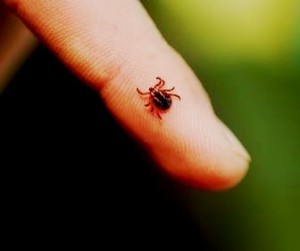
 Woodstock Early Bird has a dog who has tested positive — via a blood test –for exposure to the bacteria that causes Lyme Disease. The dog is currently undergoing a course of antibiotics and vaccinations in an attempt to keep the most serious or lethal symptoms at bay.
Anecdotal evidence from other Woodstock Early Birds is that “The ticks are really, really bad this year…” with stories of ticks a-go-go from ankles to ears of canines and humans alike.
Anecdotes are great, but what is the science behind what we are experiencing? Some of the science is data collected from area vets who are seeing more and more animals either exhibiting symptoms or testing positive for exposure.
We thought we’d check in with Dr. Brad Burrington of Veremedy Pet Hospitals to get a little more background on this “bug” and this issue. For more information, check out the BLOG at Veremedy’s website or call one of the Veremedy offices in Woodstock or White River Junction: 457-2229 or 295-6900.
LYME VACCINATION UPDATE
 By Dr. Brad Burrington, DVM
It is rare for consensus to occur on many disease topics in the medical world, and Lyme disease in both dogs and humans is particularly rife with controversy. For years there has been a debate on the value of vaccinating dogs against Lyme disease; a debate featuring a concern that the vaccine could actually make the worst form of the disease more likely to occur. At Veremedy, we shared that concern, and took a first-do-no-harm approach to the Lyme disease vaccine. Based on recent research and conversations with leading Lyme disease experts in the field, we now believe that routine use of the Lyme disease vaccine is unlikely to make the disease worse, and in fact it may prevent some of the very worst forms of this difficult disease.
To review, most dogs (as in 90%) exposed to the causative agent of Lyme disease, Borrelia burgdorferi, do not develop clinical signs of the disease. They mount an antibody response, but they do not get sick. Some dogs do get sick, they spike a fever, they develop a painful joint condition, and they become lame and lethargic. Nearly all of these dogs improve dramatically with antibiotic and anti-inflammatory medication. There is a very rare form of Lyme disease in dogs, it does not seem to occur in humans, that results in a fatal kidney condition known as Lyme Nephrosis. This disease is particularly frustrating in that the damage to the kidneys is not caused by the bacteria, but rather, by the body’s immune response to the bacteria. It is this immune-mediated nature of the disease that gave many experts concern about the possibility that the use of an immune-stimulating vaccine might make the kidney form of Lyme disease more common, not less.
Dr. Richard Goldstein, a leading expert on both kidney disease and Lyme disease, has done research that he believes demonstrates that vaccination of dogs against Lyme disease does not increase its likelihood, but in fact decreases this form of the disease. Veremedy has researched recombinant DNA technology that is used in one of the leading pharmaceutical company’s Lyme vaccine, and we believe it is safe and effective. Additional research has shown that increased use of Lyme vaccine does not increase the number of kidney cases, but in fact, the use of the vaccine likely decreases this dreaded form of the disease.
So, since our largest fear, that the vaccine would cause more kidney disease, does not seem to be the concern some experts postulated, and since the leading kidney expert recommends the use of the vaccine to prevent the worst form of the disease, and since there is newer vaccine technology for Lyme disease, Veremedy Pet Hospital now recommends routine screening for this disease and routine vaccination. We can still find experts who disagree with this approach, but all of the veterinarians at Veremedy, none of whom had vaccinated their personal dogs against Lyme disease in the past, recently vaccinated all of their canine pets against Lyme disease.




 Julia Carlisle
 Woodstock Early Bird